
Legend before a fixed image
The famous dream narrative is set in the Tang court, but surviving retellings and later additions do not produce a single uncontested life. Early textual setting and later visual history should therefore be kept distinct.
The name and demon-quelling role become a framework that later artists and communities can reshape.
Paintings and carved objects
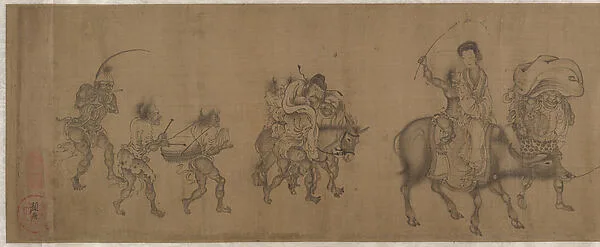
Ming and Qing objects show Zhong Kui alone, with demons, with attendants, or in family and celebratory scenes. Brush, carving material, format, and intended setting change the emotional tone.
The Met bamboo carving and Ren Yi painting are useful not because they define all Zhong Kui imagery, but because they are dated, inspectable records of different visual choices.
Seasonal and threshold display
New Year and Double Fifth contexts bring the demon-queller into calendars of protection and renewal. Prints make the image reproducible and suitable for household display, while the door or threshold gives the protective role a physical location.
This functional history helps explain why fierce imagery can carry a beneficial or auspicious purpose.
Contemporary remaking
Film, comics, advertising, and games recombine older visual materials for new audiences. A modern tiger, sword, robe, or judge-like setting may invite comparison without preserving the older story attached to another object.
The correct question is not whether the modern image is authentic in the abstract, but which elements are visible, which sources are comparable, and what the new work actually confirms.